
Beginner's Guide to Footwear and Socks for Backpacking

Table of Contents
Types of Hiking Footwear
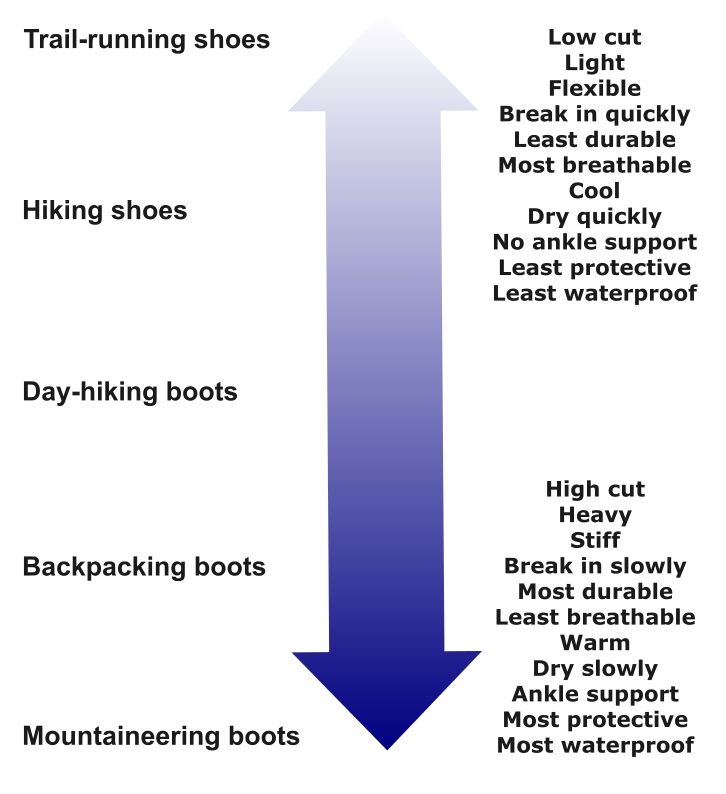
Hiking footwear products lie somewhere on the following spectrum:
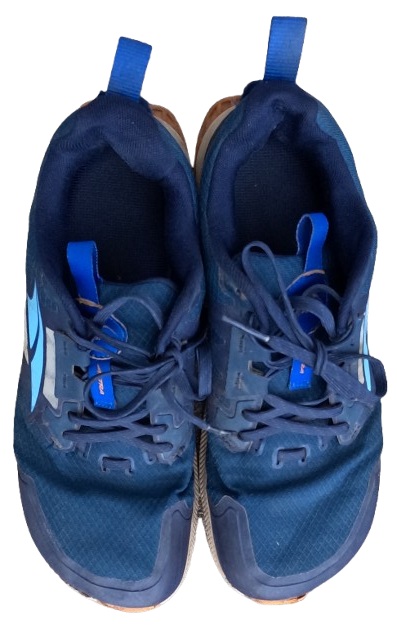
Altra Lone Peak 6
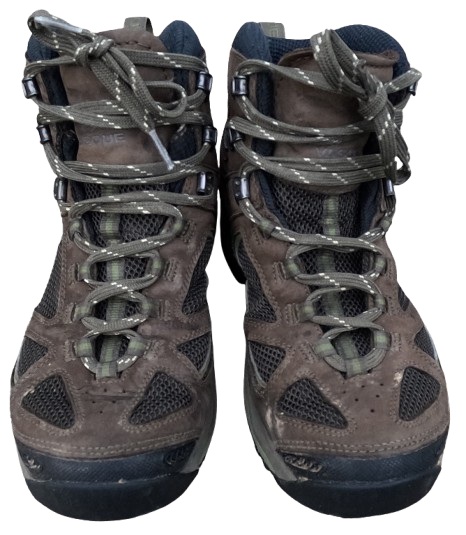
Vasque Breeze, Gore-tex
Choosing Footwear
Ask ten people about hiking footwear, and you’ll get ten contradictory opinions. Different feet require different footwear.
The conventional wisdom has been that backpackers should wear backpacking boots to prevent foot injury. This is no longer the consensus. Intuitively, backpacking boots may seem better for supporting your ankles, protecting your feet, and keeping them dry, but it’s not that simple.
Ankle Support
Various outdoor gear websites, forums, and product-testing outlets claim that features like high-cut uppers, stiff collars, torsionally rigid midsoles, lateral heel flare, and rock plates reduce the risk of ankle rolls.1,2 These claims are intuitive and may hold some truth, but they’re not well supported by peer-reviewed research. Studies on collar height and heel flare contradict each other, and only a handful of studies have tested collar or torsional stiffness.
The peer-reviewed literature comes closer to a consensus on one factor: higher stack height (thicker midsoles) has been associated with reduced ankle stability across multiple independent studies.3,4,5
Separately, higher friction on the lateral edge of the outsole has been linked to increased ankle-sprain risk in a randomized trial, though this evidence comes from a single research program rather than a broad consensus.6
All else being equal, your best bet for reducing the risk of ankle rolls is to wear footwear with low stack height. However, ankle stability isn’t the only concern for choosing footwear.
Foot Protection
The sturdy toe boxes and high-cut uppers of hiking boots make them superior for protecting your feet on rugged, rocky terrain.
Weight
One pound on your feet requires about five times as much metabolic energy as one pound on your back. Hiking boots are heavier than hiking shoes, which are heavier than trail-running shoes. Trail-running shoes are the clear winners for reducing fatigue.
Staying Dry
Hiking boots are more waterproof than hiking shoes or trail-running shoes, but they’re less breathable and more likely to leave your feet damp with sweat. They also take much longer to dry. Trail-running shoes dry the fastest. However, in snowy or slushy subfreezing conditions, insulated waterproof boots are essential.
Special Features
Trail-running shoes can have special configurations such as wide toe boxes, low stack, and zero heel-to-toe drop. These features are appropriate for some feet and inappropriate for others.
Gore-Tex Footwear
Gore-Tex footwear may not be breathable enough to justify the cost. It also takes long to dry when wet from mud, stream crossings, or sweat. However, Gore-Tex boots may be appropriate in snow and cold weather .
Conclusion
This topic is too complex, subjective, and controversial to address in this article. To determine what footwear is best for you, consult a pedorthist or podiatrist. As a cheaper alternative, some sports shoe stores provide a free gait analysis and recommendations. Fleet Feet franchise stores will measure your feet with 3D scans and computerized pressure plates. Some of their stores will offer a free consultation with a physical therapist.
My only advice is to make sure your footwear is durable enough not to blow out when you’re at the top of a mountain 10 miles from your car.
Footwear Construction
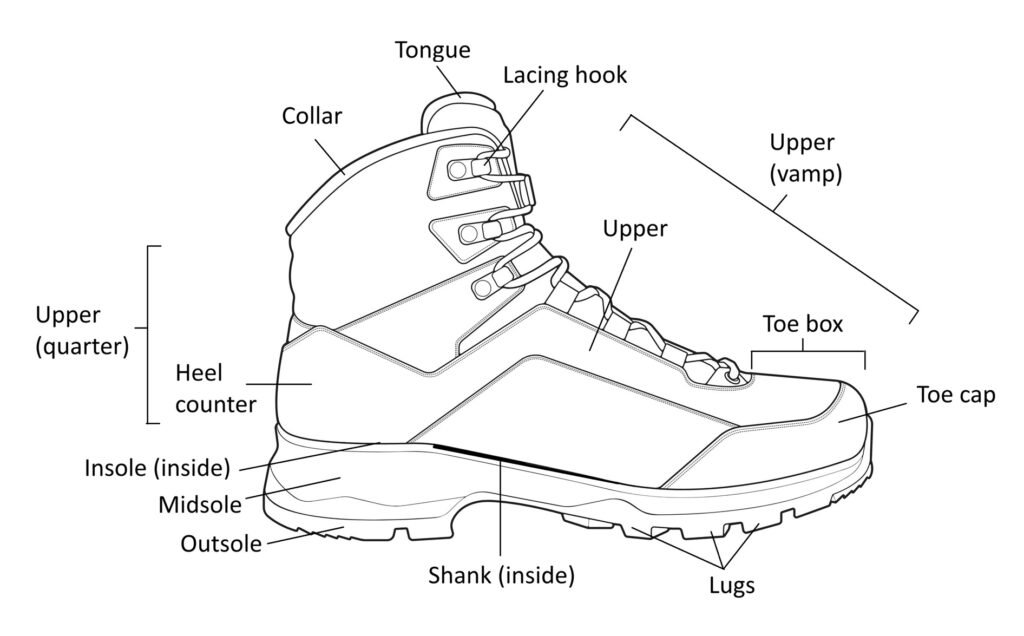
Footwear Glossary
| Term | Definition |
|---|---|
| Collar | Portion surrounding the ankle at the topline, often padded |
| Heel-to-toe drop (aka drop) | Difference between the height of the cushion at the heel and the cushion at the forefoot |
| Footbed | Surface that contacts the bottom of the foot; may be the insole or a removable cushion on top of the insole |
| Insole | Lining built into the bottom fo the shoe (not removable) |
| Lining | Material on the inside of the shoe |
| Lugs | Treads extending on the outsole to provide traction |
| Midsole | Layer between insole and outsole; provides cushioning |
| Outsole | Outermost layer of the sole. Provides durability and traction |
| Quarter | Rear part of the upper, surrounding the heel, behind the vamp |
| Rock plate | Protective insert between the midsole and outsole of trail running shoes. Protects the foot from sharp objects to prevent injuries such as bruises and punctures. Typically made of hard plastic or carbon fiber. |
| Shank | Optional supportive structure between the insole and outsole along the length of the arch, usually only in heavy boots |
| Stack height (aka stack) | Maximum height of the midsole |
| Toe box | The space containing the toes |
| Tongue and Lacing | adjust fit transport moisture from the sock to the outside where it can evaporate |
| Topline | The top edge of the upper |
| Upper | Top portion of the shoe that covers the top of the foot from heel to toe; includes the quarter, vamp, tongue, and lining. |
| Vamp | The front part of the upper, in front of the quarter |
Hiking Socks
Hiking Sock Materials
Make sure your socks don’t contain cotton, as it absorbs moisture, which can cause blisters.
Merino wool socks regulate temperature and prevent foot odor but wear out quickly.
Synthetic socks last long but stink from foot odor.
I recommend a blend of merino wool and synthetic fiber.
Liner Socks
Liner socks are thin, light, highly breathable socks worn under hiking socks. They often have a separate compartment for each toe. Liner socks wick and evaporate perspiration from your feet to prevent blisters. Although not necessary, they’re worth the price. On hot days, you can keep your feet cool by wearing only liner socks without hiking socks.